
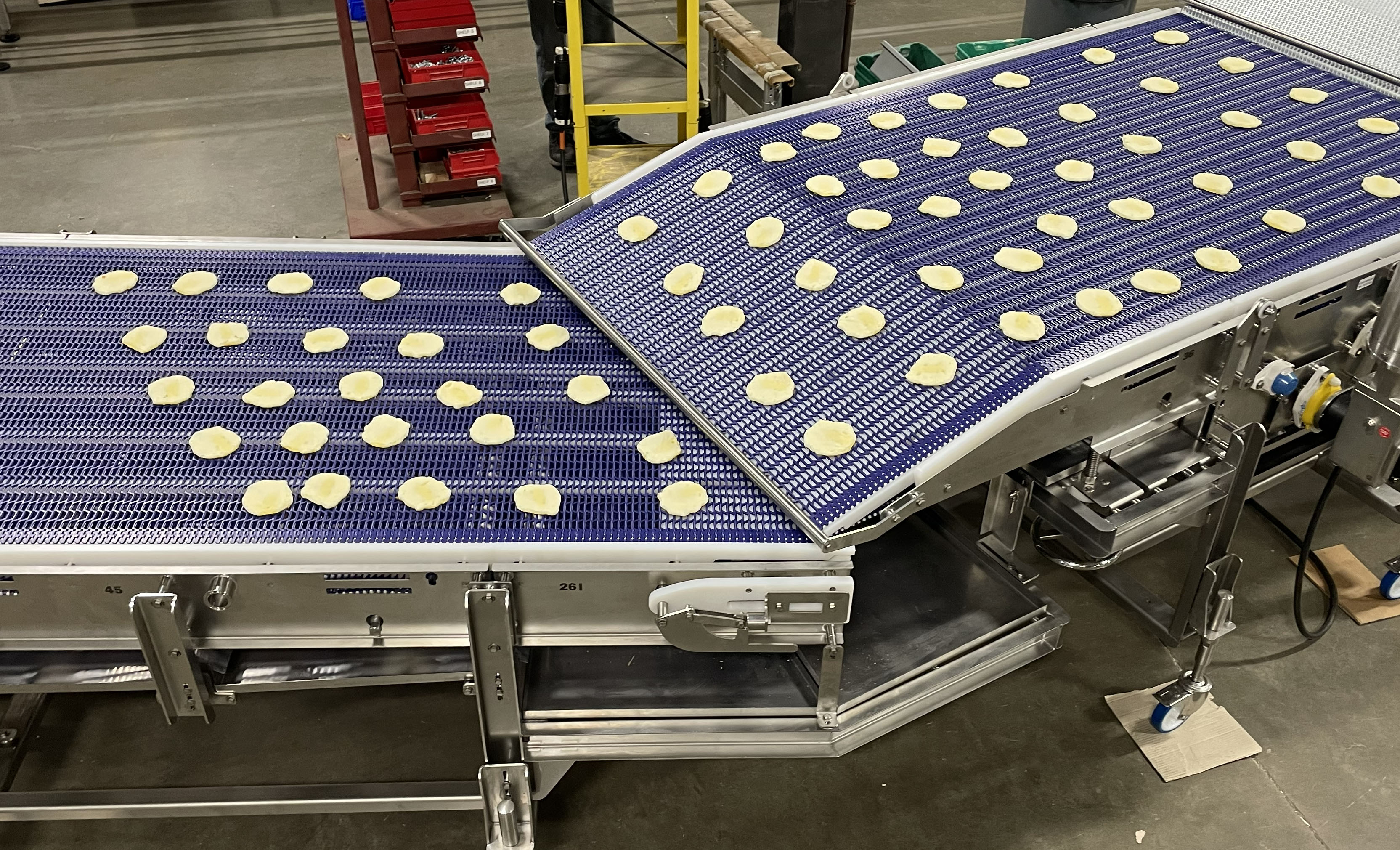
316 vs 304 Stainless Steel for Food Processing Lines
Why “Stainless” Isn’t Universal
Just because a conveyor is shiny doesn’t mean it’s safe. For equipment used in food processing, the term “stainless” is often treated as a catch-all, but this oversimplification can be a multi-million dollar mistake. Stainless steel is not a single material. It is a broad category of iron-based alloys, each engineered with a specific chemical recipe to handle different environmental stresses.
The greatest hidden danger in a food plant isn’t visible rust - it is pitting. Pitting is a form of localized corrosion that creates microscopic, needle-like holes in the metal’s surface. These tiny craters may sound non-threatening, but to a conveyor system, they are the “boogie man” with the potential to wreak costly havoc by acting as bacterial strongholds. Once pathogens like Listeria or Salmonella colonize a pit, they are shielded from high-pressure sprays and chemical sanitizers. To the naked eye, the conveyor may still look clean, but once 304 reacts with high-concentration chlorine, it stops looking like smooth steel and starts looking like broken cast iron - rough, dark, and physically pitted.
Grade 304: The Versatile Workhorse
Grade 304 is the most common stainless steel used in manufacturing globally. Its chemical composition is roughly 18% chromium and 8% nickel, which is why it is often referred to in technical circles as “18/8 stainless.” This combination creates a durable material with excellent oxidation resistance.
Grade 304 is the right-sized solution for many conveyor applications. It is exceptionally effective for:
- Dry Goods. Cereal, grains, and flour where moisture is limited.
- Secondary Packaging. Moving cases, cartons, or wrapped products that do not have direct contact with the metal.
- Standard Washdown. Environments where water is used for cleaning, but the sanitizing chemicals are not highly acidic or saline.
For facilities operating dry lines, 304 provides a perfect balance of structural integrity and cost-efficiency. It handles physical wear and tear beautifully. Its only real Kryptonite is prolonged exposure to chlorides.
Grade 316: The Shield Against Chlorides
The secret sauce that separates Grade 316 from its 304 sibling is the addition of Molybdenum (usually 2% to 3% of the total weight). This chemical element is critical to food safety because it significantly enhances the metal’s resistance to chloride-induced corrosion.
Chlorides are found in the two most common places in a food plant: the product and the cleaning chemicals. Salt, brine, and high-acid foods, such as pickles, dairy products, tomatoes, and seasoned snack foods, will chemically attack 304 stainless steel, causing it to eat through the protective oxide layer. Grade 316 is often referred to as marine-grade because it was originally designed to withstand salt-heavy ocean air. In a food plant, this means it is the essential choice for:
- Raw Protein Processing. Where blood, fats, and salt-based brines are constant.
- High-Acid Ingredients. Such as citrus juices or vinegar-based sauces.
- Aggressive Sanitation. Facilities that use heavy bleach or caustic cleaners to meet strict microbial standards.
Pitting is often a “fixing problem” rather than a “pre-knowledge problem,” occurring when a facility switches cleaning crews or chemical suppliers without verifying equipment compatibility. Issues can arise when a cleaning crew increases chlorine concentrations to speed up sanitation, inadvertently eating the 304 frames and causing damage that could result in a total replacement.
The Chemistry of Surface Finish: Ra Values and Cleanability
Choosing the right metal is only the first step. How that metal is finished determines its ultimate safety. In the industry, we measure surface roughness using Ra (Roughness Average). A standard mill finish might look smooth, but it often contains microscopic peaks and valleys from the manufacturing process.
For a conveyor to be sanitary, particularly for 3-A or EHEDG standards, the surface must typically reach an Ra of 32 micro-inches (0.8 μm) or smoother. To ensure the highest levels of sanitation, Nercon sources raw materials for its custom industrial food processing equipment that have been pre-polished to specific sanitary standards, such as a #4 finish or 32 Ra, directly from the mill. Our engineering focus then shifts to protecting this integrity during fabrication, where we meticulously grind and polish every weld to match that original grade, ensuring a seamless, high-performance surface across the entire system.
Without the correct Ra value, even 316 stainless can fail. If the surface is too rough, the molybdenum shield is compromised by physical crevices where chemicals can pool and begin the pitting process.
The Financial Impact of the Wrong Choice
Choosing Grade 304 for an environment that requires 316 carries a staggering hidden cost. The initial savings on the machine’s price tag are often erased quickly.
Plant managers must consider:
- Replacement Frequency. 304 conveyors in high-salt environments may show signs of structural pitting in 3-5 years, whereas a 316 system can last decades.
- Sanitary Audit Risk. Pitted metal is a fail on most food safety audits. If an auditor can detect surface degradation, they may mandate a total equipment replacement or a line shutdown.
- Downtime and Labor. Corroded metal is harder to clean. If your sanitation crew has to spend an extra 30 minutes scrubbing shadows off a 304 frame, those labor costs compound daily.
One of the most dangerous aspects of material failure is that there are rarely any early warning signs. By the time you see it, the structural pitting has already compromised the metal’s integrity. At that stage, you are no longer looking at a simple repair or a deep clean, but a full equipment replacement that carries a massive hit to your bottom line.
How Nercon Engineers for Food Processing Plant Equipment
Engineering custom industrial food processing equipment requires a deep understanding of how specific alloys react to cleaning chemistries. At Nercon, we believe that high-grade metal is wasted if it isn’t handled with high-grade fabrication. When we build a Grade 316 system, we follow strict protocols to ensure the integrity of the alloy:
- Filler Metal Consistency. During welding, it is vital to use specific 316-grade consumables that match the parent metal. Using a standard filler rod on 316 plates would create a chemical imbalance at the joint, resulting in a weak spot that would rust and pit significantly faster than the rest of the machine.
- Sanitary Joinery. We eliminate harborage points by using continuous, ground-smooth welds. We avoid welding techniques that leave tiny gaps where bacteria can hide.
- Passivation. After fabrication, we ensure the metal is properly passivated - a process that restores the protective chromium-oxide layer that can be damaged by the heat of welding.
Building with 316 is a significant logistical challenge because it requires a 100% verification of every single component, down to the smallest odd bars and raw materials, to ensure no weak links are introduced that could compromise the system’s overall corrosion resistance.
Making the Final Call for Your Facility
Deciding between 304 and 316 isn’t a matter of good vs. better - it’s a matter of “fit for purpose.” To help you decide, consider this checklist for your specific line:
|
|
|
|
|
|
|
|
|
|
|
|
|
|
|
|
|
|
|
|
|
|
|
|
To ensure your equipment matches your chemistry, it is important to discuss your specific product and sanitation protocols with your equipment partner. At Nercon, we map your unique challenges to the right material composition, ensuring that your investment is as durable as it is safe.
Nercon is a Wisconsin-based manufacturer of conveyor systems and material handling equipment. With 50 years of engineering experience, Nercon provides high-speed sanitary and industrial conveyor solutions, from standalone units to full-line integrations, for the food and beverage industries. All equipment is designed and fabricated in the USA, focusing on durability and ease of maintenance for high-volume production environments.

Request A Quote
Looking for a solution designed specifically for your needs? Share the details of your project with us, and our team will create a customized quote tailored to your goals, budget, and requirements.